The best resistance band exercises for beginners are the ones that build real‑world strength, protect your joints, and teach your body how to move well in everyday life. At Weights & Glory, we focus a good deal on functional movement that still provides the aesthetics our clients want. To accomplish this we recommend compound exercises with resistance bands especially for the beginner. This will help you grow while improving how effective your body is at moving, or muscular efficiency. The exercises we will cover are ones we use personally and with clients because they’re simple to learn, easy to scale up or down, and incredibly effective for strength, fat loss, and injury prevention.
How resistance bands help beginners win
When you’re just starting out, you don’t need complicated machines or a huge gym. You need movements that train your whole body, build confidence, and don’t wreck your joints in the process. Resistance bands are perfect for that.
Unlike dumbbells, bands get harder as they stretch. That means the resistance is lighter at the beginning of the movement (where your muscles and joints are most vulnerable) and heavier toward the middle and end where you’re stronger. This “variable resistance” lines up with your natural strength curve and is a big reason bands are used not just with athletes, but also in rehab, post‑COVID recovery, and in older adults dealing with weakness, pain, and balance issues. Research in everything from youth athletes to wheelchair‑bound seniors has shown that band programs improve strength, functional mobility, and even mood and fatigue levels.[pmc.ncbi.nlm.nih]
That’s the science. Now let’s walk through the actual exercises we use with beginners all the time.
Banded squats: your lower‑body foundation

If you’re new to training, squats are one of the most important movements you can learn. They carry over directly to getting out of a chair, climbing stairs, and playing with your kids. Adding a band makes them both joint‑friendly and more effective.
With a band anchored under your feet and across your shoulders or hips, the load is lighter at the bottom and heavier as you stand up. That protects your knees and hips where they’re weakest, but still forces your quads and glutes to work hard as you reach the top of the rep. Studies comparing bodyweight and banded leg work show that band exercises can produce equal or slightly greater strength gains when the program is progressed properly.[pubmed.ncbi.nlm.nih]
With beginners, we often start with:
- Banded box squats (to a chair or box) for confidence and depth control
- Then progress to full banded squats once the pattern looks solid
This gives you a safe way to build strength in your legs without needing a heavy bar on your back.
Hip thrusts: building strong, protective glutes
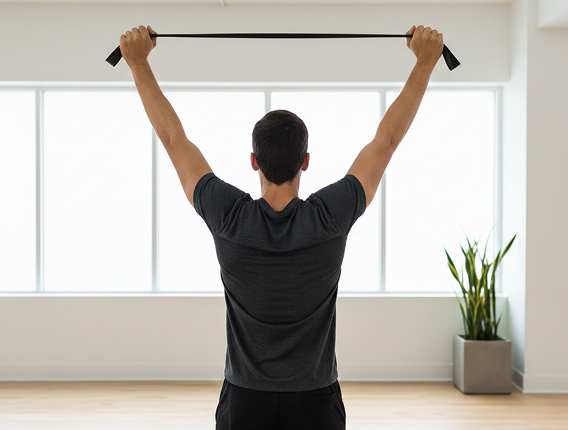
If squats are the king, hip thrusts are the close cousin that beginners usually underestimate. Strong glutes protect your lower back, knees, and hips, and they’re a major driver for walking, running, and lifting. A banded hip thrust lets you load the glutes heavily at the top of the movement, where they’re strongest, while keeping the bottom more forgiving.
That makes hip thrusts especially helpful if you’ve had low‑back or hamstring issues. When we’re working with clients who are rebuilding after injury, or just sitting a lot for work, a simple setup—upper back on a bench or couch, band over the hips, feet planted—goes a long way. Research on hip and lower‑body band exercises shows that well‑designed elastic‑band work can increase muscle forces around the hip and reduce joint loading in a way that’s helpful for long‑term joint health.[e-century]
Banded lunges with gliding discs: strength, balance, and injury prevention
Lunges are one of the best “functional” lower‑body exercises you can do, but they can also be intimidating if you’ve had knee, ankle, or balance problems. That’s where our combination of resistance bands and gliding discs comes in.
Using a band for load and a gliding disc under one foot lets you:
- Control the depth and direction of the lunge
- Reduce impact on the front knee
- Challenge different parts of the quads, glutes, and hamstrings as the leg slides back or to the side
We’ve used this setup with clients overcoming ankle injuries, knee pain, and general balance issues. Because the band is lighter at the start and heavier as you return to standing, it helps you own the hardest part of the movement without jerking out of the bottom. Research comparing heel‑raise and resistance‑band exercises for athletes with ankle issues shows that band work improves functional ability and joint stability. That same principle applies here: smart banded lunges train your legs and your balance in the same movement.[pubmed.ncbi.nlm.nih]
Banded pushups: upper‑body strength without wrecking your joints
Pushups are a classic for a reason. They train the chest, shoulders, triceps, and core all at once. But not everyone can do a full pushup on the floor from day one, and some people need more challenge once they can. Bands let you bridge both gaps.
For beginners, you can loop a band around a sturdy anchor and around your torso for assisted pushups. The band helps lift part of your bodyweight at the bottom, where the movement is hardest. As you get stronger, you can flip it—loop the band across your upper back and under your hands for resisted pushups. The band adds more load as you press up, which is where you’re stronger and your shoulders are more stable.
Studies in post‑COVID individuals and young athletes show that simple band programs including push‑type movements lead to meaningful gains in upper‑body strength and performance. In our own training and coaching, banded pushups are a go‑to because they’re easy to scale up or down without changing the movement pattern.[sciencedirect]
Curls and lateral raises: simple wins for arms and shoulders
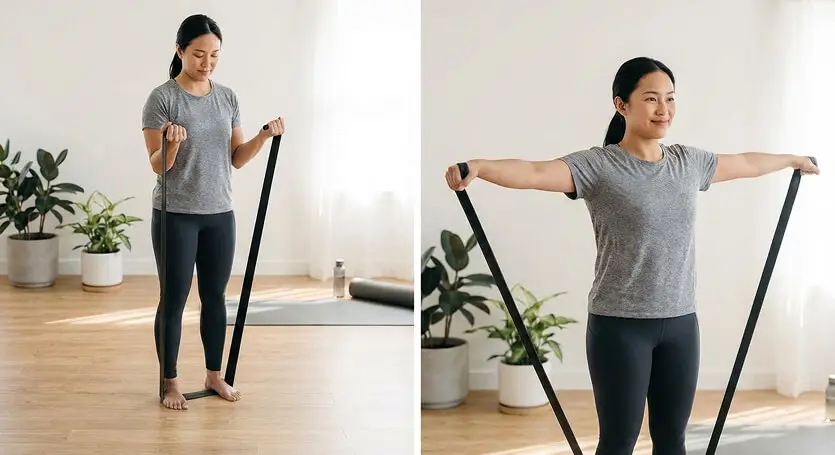
Big compound lifts are great, but beginners also need straightforward, focused work for the joints that tend to get beat up by daily life—shoulders and elbows. Band curls and lateral raises are simple, joint‑friendly, and surprisingly effective.
Band curls let you build biceps strength while keeping your wrists and elbows in a more natural path than many machines. Lateral raises with bands challenge the side delts and the small stabilizers around the shoulder blade. Research on resistance‑band shoulder and scapular work in overhead athletes shows improvements in isometric strength and shoulder function when progressive band exercises are used consistently.[observatorio-investigacion.unavarra]
For beginners, these are easy wins:
- 2–3 sets of band curls for 10–15 reps
- 2–3 sets of lateral raises or banded “Y”/“T” movements
Your shoulders get stronger and more stable, which supports everything else you do—from pushups to carrying groceries.
Ax chops and banded crunches: training the core for real life
A strong core is about more than six‑pack abs. It’s about resisting unwanted motion, transferring force from your legs to your upper body, and protecting your spine when you twist, reach, or pick something up. That’s why we love banded ax chops and banded crunch variations for beginners.
Banded ax chops train diagonal patterns—think of swinging an axe, throwing, or reaching across your body. The band pulls you into rotation while you work to control and reverse that motion. Banded crunches let you load the abs in a controlled, spine‑friendly way without needing heavy plates.
Research on band‑based core and functional programs shows improvements in plank endurance, posture, and functional performance in youth players and older adults. In our experience, combining ax chops with banded crunches gives beginners a simple but powerful core combo that carries into everything else they do in the gym and in life.[semanticscholar]
How to put these exercises together
If you’re just starting with bands, here’s a simple beginner template that uses the movements we’ve talked about:
- Banded squats
- Banded hip thrusts
- Banded lunges with gliding discs
- Banded pushups
- Band curls or lateral raises
- Ax chops + banded crunches
You can:
- Perform 2–3 sets of 10–15 reps for each exercise
- Train 2–3 times per week on non‑consecutive days
- Focus on slow, controlled reps and keeping tension on the band the whole time
Most of the research showing strength, mobility, and functional gains with bands used programs in the 6–12 week range, with consistent progression in band tension, reps, or exercise complexity. The same approach works here. Start where you are, then slowly add resistance or volume as the movements get easier.[pubmed.ncbi.nlm.nih]
The Important Goal For Beginners
At Weights & Glory, the goal is not just to help you “work out,” but to help you move well, stay healthy, and steward your body for the long haul. Bands are one of the best tools for beginners because they meet you where you are: at home, in a small space, with a body that may not feel perfect yet.
We’ve used these exact exercises—banded pushups, squats, hip thrusts, ax chops, lunges with gliding discs, curls, lateral raises, and banded core work—personally and with clients coming back from injuries, dealing with mobility issues, or just getting started. The research backs up what we see every week: bands build real strength, improve function, and protect your joints while you learn how to move.[pmc.ncbi.nlm.nih]
If you’re a beginner and you’re not sure where to start, start here. Grab a set of bands, pick a few of these movements, and commit to showing up consistently. You don’t need a perfect body or a perfect gym—just a willingness to train wisely, listen to your body, and keep stacking good sessions. Over time, the strength, confidence, and freedom you build will reach far beyond the workout.