How to Use Resistance Bands for Rehabilitation
When you’re coming back from an injury, the goal is simple: heal well, get strong again, and stay out of the doctor’s office. You want something that is effective, safe, and realistic for real life. Psalm 92:14 tells us God’s plan for us as we get older or deal with injury, “They will still yield fruit in old age; They shall be full of sap and very green”. Both injury and age happens, but it doesn’t mean we don’t have tools to still bear fruit and have vibrance and strength. That’s where resistance bands make a big difference. They give you enough resistance to rebuild strength, heal, and function, but in a way that respects your joints, your pain levels, and your confidence. I’ve personally used bands to rehab my own shoulder and hamstring, and we’ve used them with clients for stretching, mobility, strength, and balance work after injuries. That real‑world experience lines up perfectly with what the research shows.
Why Bands Make Sense in Rehab
Traditional weights use gravity and provide a constant load through the whole movement. That’s great for healthy lifters, but it can be rough on joints and tissues that are healing. Bands work differently. As the band stretches, the resistance increases, which means it’s lighter at the beginning of the movement—where your muscles and connective tissue are at their weakest and most vulnerable—and heavier toward the middle and end where you’re stronger. This variable resistance lines up better with the natural force curve of your muscles and joints, which is exactly what you want in rehab and injury prevention. But with traditional weights you don’t have this benefit, so if you go with lighter weight you don’t have the resistance where you need it and if you stay heavier you run a higher risk of injury.

That “lighter at the bottom, heavier at the top” effect lets you move through painful or stiff ranges with less threat, while still getting plenty of stimulus where your body can safely handle it. For someone recovering from an injury, that can be the difference between building back stronger and faster versus causing reinjury and flaring things up. It’s also why bands are used so often in clinics, cardiac rehab, and fall‑prevention programs, not just in gyms. If you want a broader look at how this plays out beyond rehab, you can read our guide on how resistance bands elevate home workouts.
What the Science Actually Shows
A lot of people think of bands as a watered‑down version of “real” strength training, but the data says otherwise. In patients with heart disease, a short‑term resistance program using elastic tubing improved lower‑body strength and functional capacity to a meaningful degree after just six weeks. Knee extension and flexion strength both went up, and their walking capacity improved from about 485 meters to almost 580 meters in a standard walking test. That’s a big jump in how far and how confidently they could move in everyday life. And that is great for functional fitness and everyday life.
A meta‑analysis of elastic resistance training in older adults found significant improvements in functional tests like the 30‑second sit‑to‑stand, Timed Up and Go (TUG), 6‑minute walk, arm curls, grip strength, and flexibility when compared to doing nothing at all. These are the same tests therapists use to decide if someone can get up from a chair safely, walk across a room without falling, or manage daily tasks without help. In other words, bands are not just “better than nothing”—they are a legitimate method for rebuilding strength and improving function. If you’re new to this kind of training, start with our article on the best resistance band exercises for beginners so you can build a solid foundation.
Rehab, Balance, and Fall Prevention
One of the biggest concerns after injuries—especially for older adults—is falling. This most often happens when strength, balance, and confidence all drop at the same time. Elastic‑band programs directly target those areas. A recent review on lower‑limb elastic band training in older adults showed strong improvements in strength and balance, with benefits seen in both healthy seniors and those with medical issues.
In one study, older adults with mild cognitive impairment did an elastic‑band program in cycles of training, detraining, and retraining. Even with a break in the middle, they still improved muscle power and reduced fall‑risk scores on tests like TUG and other fall‑risk assessments, and some of those gains held during the off period. That tells you two things:
- Bands are strong enough to create real change.
- The benefits are meaningful enough to carry over beyond the training window.
In our own coaching, we’ve used bands with clients who were dealing with mobility, strength, and balance issues after surgeries, sprains, and chronic pain. We’ve seen them move from needing support just to stand up, to confidently performing controlled band squats, rows, and step‑backs with much better stability. The research backs up what we see in the gym everyday. When used consistently, bands help people feel more stable on their feet and less afraid of movement. For practical ideas on weaving this into your weekly routine, see our guide on incorporating resistance bands into your fitness routine.
Pain, Stiffness, and Confidence in Movement
Rehabilitation isn’t just about muscle strength. It’s also about pain, stiffness, and the mental side, specifically the fear of reinjury. Several studies using elastic‑band programs in people with chronic musculoskeletal pain have shown significant drops in pain scores and disability, along with improvements in flexibility and core or limb strength.
Because bands let you adjust resistance simply by stepping closer or further away, changing the band, or changing the angle, you can easily find a level that challenges the muscle without overwhelming the joint. That makes it much easier to get someone moving again who’s been guarding, bracing, and avoiding certain movements. I’ve experienced this personally when rehabbing my shoulder. Especially with a ball and socket joint the ability to change angles and tension makes a huge difference. Being able to gently load those tissues at the start, then progressively increase the stretch and tension over time, allowed me to push for progress without constantly feeling like I was risking a setback.
How to Actually Use Bands in Rehab
Every rehab plan should be individualized, but there are some simple principles you can follow when you’re using bands to come back from an injury.
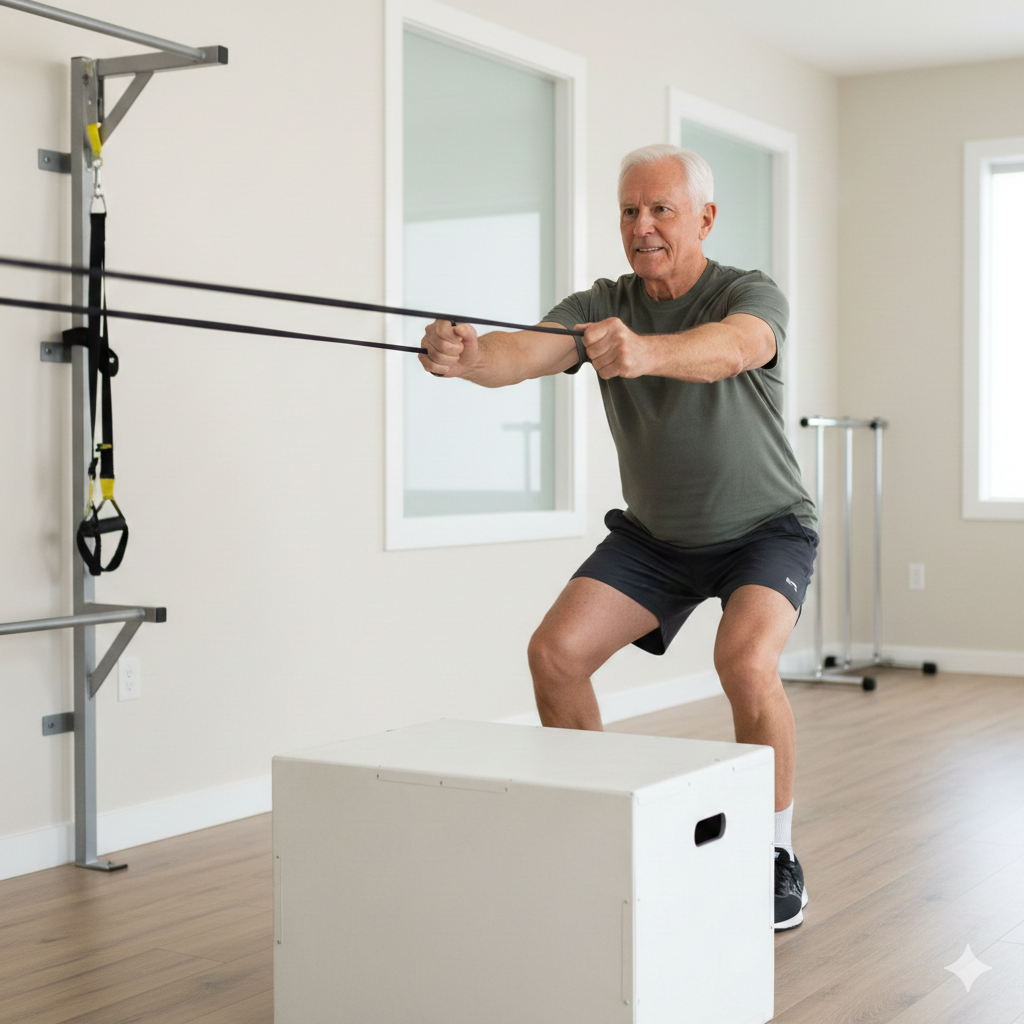
- Start in the safest range of motion. Use shortened‑range or supported movements first (for example, mini‑squats to a high box with a light band, or assisted rows) and gradually increase depth and range as symptoms improve. This respects the weaker portion of the force curve while still letting you practice the movement.
- Keep tension on the band through the whole rep. You don’t want the band completely slack at the start; there should be mild tension even at the beginning so the muscle stays engaged and controlled through the range. This is key for both strength and joint stability.
- Focus on controlled tempo. In rehab, slower eccentrics (the lowering phase) and controlled movement pay off. They allow muscles, tendons, and the nervous system to rebuild strength and coordination without jerky motion.
- Progress the load gradually. You can progress bands by choosing a stronger band, increasing the stretch, adding more reps or sets, or changing the angle to make the leverage harder. Many of the studies showing strength and function gains used simple, progressive overload like this over 6–12 weeks. If you want a step‑by‑step structure for your workouts, our resistance band exercises guide can give you movement ideas and progressions.
- Combine strength, mobility, and balance. One of the best things about bands is that you can train multiple qualities at once. We regularly use them with clients for dynamic stretching (like band‑assisted hamstring or shoulder mobility work), strength (rows, presses, squats), and balance (single‑leg band reaches, lateral steps, or hip work).
Where This Fits the Weights & Glory Approach
At Weights & Glory, the goal is not just to get you “back to normal” after an injury, but to help you build strength and resilience that carries into real life—work, family, and the calling God has on your life. Bands fit that vision perfectly. They are portable, affordable, and easy to use at home, at the park, or on the road, but they are also backed by strong evidence for improving strength, balance, and functional capacity in people who need it most. And they pair beautifully with a faith‑driven mindset; if you’d like to reflect more on that, read Why Faith Matters in Fitness.
Because bands naturally work with the force curve—lighter where you’re weakest, heavier where you’re strongest—they allow you to stack consistent, safe training sessions instead of bouncing between overdoing it and doing nothing. That consistency is where real rehab happens. It’s what helped me rebuild my own shoulder and hamstring, and it’s what we’ve seen in clients who thought their best days of movement were behind them.
If you’re recovering from an injury, dealing with long‑term pain, or just trying to protect your joints while you stay active, resistance bands are not a consolation prize. Used correctly, they’re one of the most powerful tools you can add to your rehab and prevention toolbox—helping you move better, feel safer, and get back to the things God has called you to do. If you’re ready to support that journey with smart planning and nutrition, explore our fitness calculators to dial in your daily calories, macros, and more.