When losing weight or building muscle you want to make sure your fitness program is effective. This means your gym setup, whether at home or elsewhere, needs to have the right equipment to help you reach your goals. And the question always comes up, “are resistance bands as effective as free weights?”. Both free weights and resistance bands are excellent tools for fitness. We have used both for years. Numerous studies show free weights and resistance bands do affect the muscles differently but there is a ton of evidence that shows resistance bands can match traditional weights for both strength and hypertrophy. I personally have used resistance bands exclusively for 5 years as a personal test and my results were the exact same as the scientific studies. When used properly, you will lose fat, gain muscle, get stronger, and feel good. But there are added benefits that resistance bands have that free weight have trouble matching, and we will get into that in this article. By the end of this you will have a much better understanding of the type of setup that works for you.
How resistance bands and free weights actually work
Resistance bands have been used in fitness for decades. But during the Covid pandemic the use of resistance bands have become much more popular. Most resistance bands are made of latex or rubber. Being lighter than free weights, resistance bands are much lighter and easier to use when traveling and take far less room to store. But there is a significant difference in how they provide resistance compared to free weights.
All weights use gravity to create resistance. Machines will employ pulleys or levers to create resistance in a variety of directions. But free weights do not have any attachments, that’s why they are free, so the resistance is always vertical. The weight itself never changes so the level of resistance also never changes. Resistance bands however generate force by being stretched which allows the resistance to be in any direction. Resistance bands also increase in tension the further they are stretched, this is called variable resistance. This means the level of resistance increases and your rep progresses instead of staying constant like free weights. The nature of this changes how it affects your body and how you need to develop your fitness program.
Working Opposite the Force Curve
Recently there has been a lot of content coming out about the force curve and its importance on growth and strength. Often at the beginning of an exercise and force curve the muscle being worked is lengthened. This is when the muscle is at its weakest point, both for strength and vulnerability to injury. This is why the force curve is also called the strength curve. Recent studies have shown that stimulus at the beginning of the force curves stimulates more growth than near the middle or end of the curve.
The problem is that this is also the place where more injuries happen. And while there is some additional benefit to a certain level of resistance at the beginning of the force curve the additional benefit is marginal for most people but the risk of injury is significantly greater. So in terms of safety resistance bands get a huge win. Dropping even the heaviest resistance band on your foot would result in no injury, while dropping even dropping a 60 pound weight on your foot could be devastating.
How do we know how effective exercises are for muscles?
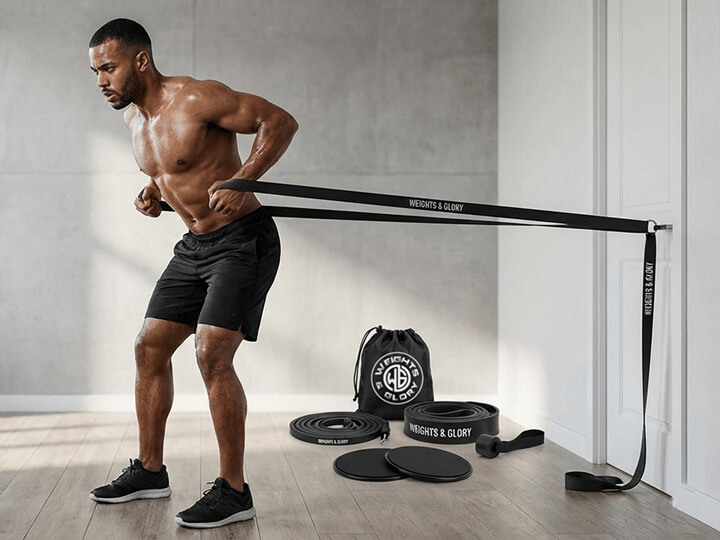
Muscles grow the muscles and fibers within them are activated. EMG (electromyography) is a scientific process that measures the amount that a particular muscle is activated. This is extremely helpful because while an exercise may feel more difficult it may not necessarily provide more activation and growth for the muscle. EMG helps show what actually will get you results and growth.
The EMG data from multiple studies show that bands and free weights stimulate muscle groups in slightly different ways, and that often depends on the types of exercises performed. Particularly in upper‑body flyes and reverse flyes, dumbbells tended to edge out bands in the primary targeted muscles like the pecs and rear delts. This is especially true at the beginning of the force curve where leverage is toughest and muscles and joints are at the highest risk for injury. But as the band stretches and tension ramps up, activation in those muscles catches up, but the surrounding stabilizing muscles like the middle delts and traps actually fire significantly more with bands. For specific individual muscles free weights are slightly stronger but in regards to whole muscle groups there is a larger net gain for resistance bands.
Strength and hypertrophy: can bands really build as much muscle?
Generally when training clients we will measure muscle growth and set programming over a 6-8 week period. Multiple studies have mirrored that time frame and have shown “no significant” difference in muscle thickness (hypertrophy) or strength. When it comes to strength and growth the thing that matters most in your fitness program are not the types of resistance you use, but the intensity and volume in your program. If you are trying to lose weight this will be something that is very important to your goal. The more muscle you are able to build the easier it will be to lose fat, and both typically happen at the same time. We often tell our clients the fastest way to lose fat is to build muscle.
Other Areas of Growth in Resistance Bands
The other thing to consider is the purpose of your training. For untrained individuals, sedentary middle‑aged women, and athletes, comparable gains in strength, power, and muscle thickness were experienced after 6–8 weeks of resistance band training versus weight training when both used the same training technique of progressive overload. But everything does not come down to strength and hypertrophy. If you are interested in speed, agility, and power, studies have shown that short-term elastic-band programs in team sport athletes (e.g., soccer players) improved in all three areas to a similar extent as traditional resistance training.
Where Free Weights are Better
We had mentioned that in some exercises using free weights can target a specific muscle far better than muscle groups. So if you are a body builder or a professional athlete, you may not want to get rid of free weights all together. Fine tuning specific muscles that are critical for your application may be something you want that extra edge on. There also is going to be a limit to the amount of resistance you can gain with resistance bands. For a vast majority of the population you will not need more weight than what the resistance bands can provide. Our set can easily gain you over 300 pounds of resistance by only combining two bands. But for those who are proficient power lifters or those seeking to compete in strongman competitions, Getting past that 600 pound threshold will only happen with actual weights. Exercises like squats are the ones that particularly come to mind.
Where Resistance Bands are Better
The flexibility that resistance bands provide are very hard to match. To have a complete gym in a bag that weights less than 5 pounds is a huge advantage to many. To be able to travel and set up a gym anywhere in the world without compromising results is a game changer for your health. Resistance bands also do well for people who are concerned with injuries, mobility, and joint issues. The way the bands work along the force curve makes it much easier to recover from injuries and prevent many injuries that happen in the gym. Unlike free weights, which lock you into vertical resistance and can stress joints under heavy constant loads, bands let you move in any direction—perfect for functional training that mimics real-life movements like twisting, pulling, or lateral steps. For beginners especially bands are a win. But bands are also great for busy parents, or anyone over 40 looking to stay consistent without the intimidation of a loaded rack, bands deliver progressive overload that’s forgiving yet effective. They’re budget-friendly and space-efficient—no need for a dedicated squat cage or bumper plates cluttering your garage. So if your goals prioritize convenience, longevity, and all-around usability over maxing out elite lifts, resistance bands give you an edge that free weights simply can’t touch.
What Happens If You Combine Free Weights with Resistance Bands?
Some of you may be in a position where you are thinking about adding resistance bands to your free weight exercise program. Afterall, if possible, why not get the best of both worlds? For athletes, studies have shown that improvements in power, output, and rate of force development occur with banded squats and deadlifts when the bands contribute 15–35% of the top-range load. It has also been shown in trained lifters that combining resistance bands to a free weight program led to an increase in peak power and loading at specific joint angles by adding variable resistance across the range of motion.
So by adding this additional dynamic into your workout, you challenge your muscles through variable resistance that matches the body’s natural strength curve—lightest at the bottom where you’re weakest and heaviest at the top where you can handle more load. This not only boosts peak power and rate of force development but also improves joint stability and neuromuscular efficiency, making it a smart upgrade for trained lifters aiming to push past plateaus. The added benefit to blending free weights with bands in this targeted way lets you harness the precision of barbells with the explosive adaptability of elastic resistance, delivering superior results across strength, speed, and power, while also achieving the extra growth by still supplying resistance at the beginning of the force curve.
The Bottom Line: Resistance Bands vs. Free Weights
Here’s a quick recap of what we’ve covered:
- Strength & Hypertrophy: Resistance bands match free weights pound-for-pound when you focus on progressive overload—no significant differences after 6-8 weeks.
- Where Free Weights Win: Better for isolating specific muscles (like in flyes) and maxing out heavy lifts over 300-600 lbs for powerlifters or bodybuilders.
- Where Resistance Bands Win: Unbeatable for portability, safety (drop ’em worry-free), joint-friendly variable resistance, injury prevention and injury recovery, and activating stabilizers for functional power, speed, and agility.
- Combo Power: Add bands (15-35% top-range load) to free weights for explosive gains in power, RFD, and joint stability—best of both worlds.
- Safety & Practicality: Bands reduce injury risk at weak points in the force curve and fit any lifestyle, from travel to home gyms.
In the end, neither is “better”—it depends on your goals, space, and experience. But for most folks losing fat, building muscle, or staying consistent long-term, resistance bands (or a smart combo) deliver results without the hassle. We’ve seen it in studies, clients, and my own 5-year test—pick what fits your life, stay progressive, and watch the gains roll in. Ready to level up? Grab some bands and start today.