When you’re starting a fitness journey, you want to make sure your effort actually shows up in results. You don’t need a complicated program or expensive equipment—you need movements that build real strength, protect your joints, and fit into your actual life. If you’re new to training, start with our best resistance band exercises for beginners and build from there.
Resistance bands are one of the most versatile, effective, and portable tools to achieve this. With the right band, you can achieve a full-body workout anywhere, anytime, challenging your muscles and improving mobility without the joint stress of heavy weights. But with so many options, from the best resistance straps to top-rated exercise bands, how do you choose the right one? The most common debate centers on two popular styles: continuous loop bands and resistance tubes with handles. This guide will break down the differences to help you select the perfect tool for your fitness goals.
Key Takeaways
- Effectiveness: Research confirms that resistance bands can build muscle and strength just as effectively as free weights when workouts are performed with sufficient intensity.
- Loop vs. Tube: Loop bands are flat, continuous circles of rubber, prized for their versatility in both upper and lower body workouts. Resistance tubes are cylindrical with handles, often preferred for exercises that mimic traditional weight machines, like bicep curls and chest presses.
- Versatility is Key: While tubes are comfortable for certain upper-body movements, loop bands offer a wider range of applications, including lower-body exercises, pull-up assistance, and functional strength training that engages more stabilizer muscles.
- Material Matters: The material—typically latex, TPE, or fabric—affects the band’s durability, feel, and resistance. Latex offers superior elasticity, while fabric bands are known for comfort and resistance to rolling during leg exercises.
- Our Recommendation: For a holistic, functional, and adaptable training tool, we recommend high-quality, multi-layered latex loop bands. They provide the dynamic, full-body engagement necessary for building real-world strength.
- Proper Care Extends Life: To maximize the longevity and safety of your bands, store them away from direct sunlight, clean them with a damp cloth (no harsh chemicals), and inspect them regularly for wear and tear.
Why Resistance Bands Are Essential for Your Fitness Journey
Research backs up what we’ve seen working with clients for years: when you match volume and progressive overload, resistance bands build just as much muscle and strength as traditional weights. If you want a deeper breakdown of training effectiveness, see our guide on resistance bands vs. free weights.
In fact, a 2019 analysis found no significant differences in strength gains between training with elastic bands and training with free weights. The real difference is in how bands load your body. They provide variable resistance—lighter at the bottom of the movement where your joints are most vulnerable, heavier at the top where you’re stronger. This ascending resistance challenges your muscles throughout the entire range of motion, a feature that free weights can’t match.
This unique quality makes elastic band fitness an incredibly accessible option for people at any stage of their journey. For beginners, they offer a safe way to learn proper form without the risk of dropping a heavy weight. For advanced athletes, they can be combined with free weights to increase power and strength gains beyond what weights alone can provide. Furthermore, their lightweight and portable nature makes them the ultimate home and travel gym. You can train hard without beating yourself up, which matters if you’re recovering from an injury, or just want to stay consistent without constant setbacks. An exercise band set allows you to achieve your goals, whether that’s building strength, improving flexibility, or preventing injuries, all with one compact tool.
Loop Bands vs. Resistance Tubes: Unpacking the Key Differences
When choosing the best exercise bands, the first decision is often between flat, continuous loop bands and tube bands with handles. Loop bands are especially useful for functional training, lower-body work, and assisted movements, which makes them a great fit for rehabilitation with resistance bands. While both provide resistance, their design differences lead to distinct advantages and applications in your workout routine.
Loop bands are simple, closed loops of flat, wide elastic material. Their genius lies in this simplicity. You can wrap them around your ankles for lateral walks, place them above your knees for squats and glute bridges, or anchor them to a pull-up bar for assisted pull-ups. This design makes them exceptionally versatile for functional movements that train the body as an integrated system, enhancing stability and coordination. And being flat loop bands can be stacked to combine or increase resistance levels.
Resistance tubes, on the other hand, are hollow, cylindrical bands that almost always come with handles attached to the ends. These handles offer a comfortable and familiar grip, making tubes a popular choice for exercises that replicate dumbbell or cable machine movements, such as bicep curls, chest presses, and shoulder raises. Some sets are “stackable,” allowing you to clip multiple tubes to one handle to increase the resistance.
The key differences come down to versatility, safety, and the type of resistance provided. Loop bands are generally considered more versatile, especially for lower-body and full-body conditioning. Tubes offer handles for specific movements, but loops provide more dynamic, full-body engagement. From a safety perspective, high-quality loop bands made from layered latex are incredibly durable, while tubes can be more prone to snapping at the point where the handle connects to the tube, especially in lower-quality models. Ultimately, if your goal is comprehensive functional fitness, loop bands offer a superior range of applications.
Why We Champion Loop Bands for Optimal Training
When it comes to building a resilient, functional body, we recommend and sell loop bands for several key reasons. Their design promotes a more holistic approach to fitness that translates directly into real-world strength and stability. The continuous loop allows for an incredible variety of anchor points and exercises that are simply not possible with handled tubes. This versatility is crucial for a well-rounded routine.
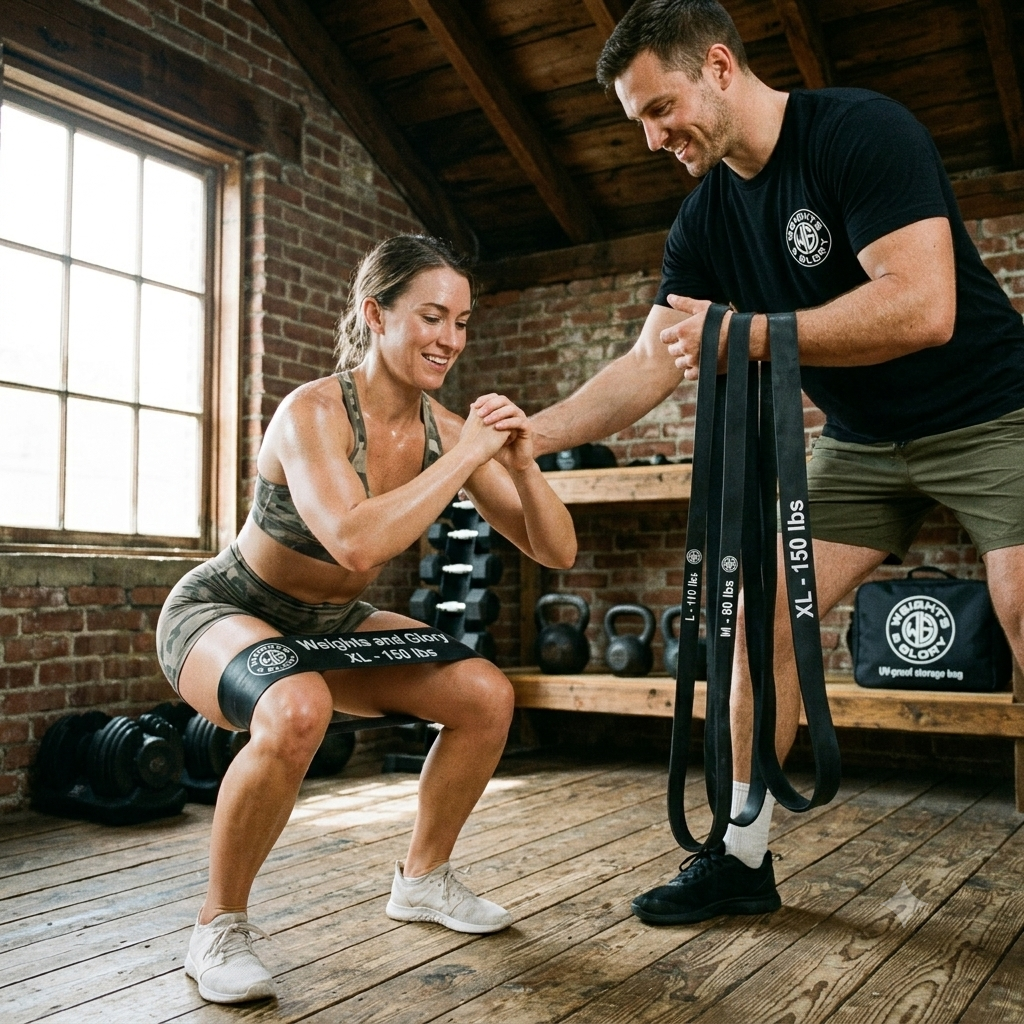
Loop bands excel at activating the smaller stabilizing muscles around your joints, which is essential for injury prevention and overall joint health. They are also a practical choice for people who need short, efficient workouts, including busy parents, so you may also like our easy resistance band workouts for moms. For example, placing a band around your knees during a squat forces your glutes and hips to work harder to maintain proper alignment. This builds strength in patterns that protect your knees and lower back. They are also unmatched for modifying bodyweight exercises; you can add resistance to push-ups or assistance to pull-ups, allowing for constant progression.
Finally, the best resistance training bands are both durable and incredibly compact. Crafted from premium, multi-layered latex, they withstand intense workouts without losing elasticity. Their flat design means you can pack an entire gym’s worth of resistance into a small bag. This combination of functional benefit, durability, and portability is why we believe loop bands are the superior choice for anyone serious about effective and sustainable fitness.
Selecting Your Perfect Match: A Guide to Top-Rated Resistance Bands
Don’t just pick any band; choose the one that truly supports your goals and delivers results. If your goal is upper-body strength, our guides on effective resistance band exercises for chest training at home and resistance band shoulder exercises can help you match the right band to the right workout. Making the right choice comes down to understanding three crucial factors: the resistance level, the quality of the material, and overall comfort and design.
First, consider the resistance level. Bands are typically color-coded or labeled as light, medium, heavy, and extra-heavy, with resistance often measured in pounds or kilograms. The right level depends on your current fitness and the exercise you’re performing. You’ll need a lighter band for smaller muscle groups like shoulders and a heavier one for powerful muscles like the glutes and legs. A quality exercise band set should offer a range of options, allowing you to progress over time by increasing resistance—a key principle for building strength.
Next, evaluate the material quality. Most bands are made from natural latex, thermoplastic elastomer (TPE), or fabric. High-quality, multi-layered latex, like that used in the Weights & Glory Resistance Bands, offers excellent elasticity and durability. Fabric bands are often preferred for lower-body exercises as they are more comfortable on the skin and less likely to roll up. TPE is a synthetic, latex-free option, but it may not offer the same longevity or consistent stretch as premium latex. Finally, consider grip and comfort. The band should feel secure in your hands or around your limbs without pinching or digging into your skin.
Your Checklist for Choosing the Right Band
To find the best workout bands for your needs, run through this simple checklist before you buy:
- Consider Your Goals: Are you focused on building maximum strength, improving flexibility and mobility, or rehabilitating an injury? For strength, you’ll need a set with high-resistance options. For mobility and rehab, lighter bands are essential.
- Assess Resistance Needs: A complete set is ideal. Match the band’s tension to your current strength and the target muscle group. A light band might be perfect for bicep curls, while you’ll need one of the top-rated workout bands with heavy resistance for squats and deadlifts.
- Evaluate Material: Understand the trade-offs. Natural latex provides the best stretch and durability. Fabric bands offer superior comfort for on-skin lower-body work but may have a more limited stretch range. TPE is a good alternative for those with latex allergies.
- Check for Comfort: Ensure the band’s width and texture are comfortable. Wider bands tend to distribute pressure more evenly and are less likely to pinch.
- How the Weights & Glory set stacks up: Our set was designed to check every box. With six distinct resistance levels from extra-light to a 180 lb XXL band, it provides true variability for any goal. Made from premium, multi-layered latex, the durability is exceptional. The included gliding discs and door anchor enhance its versatility, and it all packs into a portable bag, making it the ultimate all-in-one solution.
Material and Resistance: A Comparison Table
| Material Type | Characteristics | Durability Rating | Typical Resistance Range |
| Natural Latex | Highly elastic, smooth texture, provides consistent tension. The gold standard for performance. | High (especially when multi-layered) | 5 lbs – 200+ lbs |
| Fabric (Cotton/Polyester Blend) | Woven with elastic strands. Comfortable on skin, non-slip, and resistant to rolling. | Very High | 10 lbs – 50 lbs (Typically for lower body) |
| TPE (Thermoplastic Elastomer) | Latex-free synthetic material. Less elastic than latex and can be less durable over time. | Medium | 5 lbs – 80 lbs |
Elevate Your Routine: Effective Exercises with Resistance Bands
One of the greatest strengths of the best elastic bands for exercise is their ability to target nearly every muscle group in the body. Whether your goal is to build a stronger lower body, sculpt your arms, or fortify your core, there’s a band exercise to help you get there. For every movement, remember that proper form is paramount. Focus on controlled motions, keeping tension on the band throughout the entire exercise to maximize effectiveness and prevent injury.
Here are a few fundamental exercises to get you started with your long resistance bands:
Exercise 1: Banded Squats (Lower Body)
- Step 1: Position a loop band just above your knees.
- Step 2: Stand with your feet shoulder-width apart, toes pointing slightly outward. Keep your chest up and engage your core.
- Step 3: Lower your hips back and down as if sitting in a chair, pushing your knees out against the band’s tension.
- Step 4: Drive through your heels to return to the starting position, squeezing your glutes at the top.
Exercise 2: Bicep Curls (Upper Body)
- Step 1: Stand on the middle of a long resistance band with both feet, holding one end in each hand with your palms facing forward.
- Step 2: Keep your elbows tucked in close to your sides.
- Step 3: Curl your hands up toward your shoulders, squeezing your biceps at the peak of the contraction.
- Step 4: Slowly lower your hands back to the starting position, resisting the band’s pull on the way down.
Exercise 3: Glute Bridges (Core & Glutes)
- Step 1: Lie on your back with your knees bent, feet flat on the floor hip-width apart, and a loop band positioned just above your knees.
- Step 2: Engage your core and glutes, then lift your hips off the floor until your body forms a straight line from your shoulders to your knees.
- Step 3: At the top of the movement, actively push your knees outward against the band to increase glute activation.
- Step 4: Slowly lower your hips back down to the floor with control.
As these movements become easier, you can progress by using a thicker band with more resistance, increasing the number of repetitions, or slowing down the tempo of each rep. This principle of progressive overload is the key to continuous improvement.
Maximizing Longevity: Care and Maintenance for Your Bands
Investing in top-rated resistance bands is the first step; proper care is the second. Taking a few simple maintenance steps will dramatically extend the life of your bands, ensuring they remain safe and effective for years to come. Neglect can lead to premature wear, causing bands to lose elasticity or even snap, which poses a significant injury risk.
After each workout, it’s a good practice to wipe your bands down. Use a damp cloth to remove sweat, oils, and dirt. Avoid using harsh chemical cleaners, soaps, or alcohol-based sanitizers, as these can degrade the latex and make it brittle. For cleaning, plain water is best. Storage is equally critical. Always store your bands away from direct sunlight and extreme temperatures, as UV exposure and heat are the primary enemies of latex, causing it to dry out and crack. A closet, drawer, or a dedicated gym bag is an ideal storage spot.
Before every use, give your bands a quick visual inspection. Look for any nicks, small tears, or areas that appear thin or discolored. If you find any signs of damage, it’s time to replace the band. A small tear can quickly become a full break under tension. By investing in a quality product from the start and following these simple care instructions, you ensure your equipment remains a reliable partner in your fitness journey. That’s why the Weights and Glory resistance band set includes a UV-proof bag—to help protect your investment and keep your bands in top condition. You can purchase the set here.
Conclusion: Your Strongest Self is a Band Away
In the debate between resistance tubes and loop bands, the choice becomes clear when your goal is functional, real-world strength. While tubes with handles have their place for isolating specific muscles, loop bands offer unparalleled versatility, superior muscle activation, and a more holistic approach to fitness. They train your body as an integrated system, strengthening the large muscle groups and the crucial stabilizers that protect your joints. They are not just an alternative to weights; they are a powerful training tool in their own right, proven to build just as much muscle and strength.
The journey to better fitness doesn’t require a crowded gym or a rack of heavy iron. It requires consistency, proper form, and the right tools. A high-quality set of loop resistance bands provides everything you need to challenge your body, break through plateaus, and build strength that serves you in every aspect of life. They are portable, affordable, and endlessly adaptable to your evolving fitness level. Your body is a gift to steward well. The next step is simple: choose the tool that will help you build a stronger, more resilient you. Your first workout with the best resistance bands could be tomorrow.
Frequently Asked Questions
Can resistance bands really build muscle like weights?
Yes. Multiple studies have shown that resistance bands can stimulate muscle growth and strength gains comparable to those achieved with free weights, as long as the exercises are performed with high effort and progressive overload. The key is to challenge your muscles by working close to failure.
What resistance level should a beginner start with?
A beginner should start with a light to medium resistance band. This allows you to focus on mastering proper form without excessive strain. It’s highly recommended to purchase a set with multiple resistance levels so you can use lighter bands for upper body exercises and heavier ones for your lower body as you get stronger.
How often should I use resistance bands?
You can incorporate resistance bands into your routine 2-4 times per week, depending on your goals. For strength training, allow for at least one day of rest between working the same muscle groups. For mobility and activation work, they can be used more frequently, even daily as part of a warm-up.
Are loop bands or tube bands better for physical therapy?
Both can be used, but loop bands are often preferred in physical therapy for their versatility in strengthening stabilizer muscles and facilitating functional movement patterns, especially for the hips and shoulders. However, the best choice depends on the specific injury and the therapist’s recommendation.
Can I get a full-body workout with only resistance bands?
Absolutely. A good set of loop bands allows you to perform exercises for every major muscle group, including squats, lunges, rows, presses, curls, and core work. Their portability makes it easy to get a complete workout anywhere, anytime.
How do I know when to move up to a heavier band?
It’s time to move to a heavier band when you can comfortably complete your target number of repetitions (e.g., 12-15 reps) with perfect form and feel you could do several more. This indicates your muscles have adapted and are ready for a greater challenge.
What’s the difference between latex and fabric resistance bands?
Latex bands are known for their superior elasticity and wide range of resistance levels, making them ideal for a variety of exercises. Fabric bands are typically wider, more comfortable against the skin, and less likely to roll up, which makes them a popular choice for lower-body exercises like glute bridges and squats.